A Fighter Rises


This year, we surprisingly had snow fall in April. As the snow began to melt, I wanted to drive an R/C car in my yard. But the yard was still wet, and driving in those conditions results in the car’s body, wheels, and suspension parts caked with mud and grass. Not easy or fun to clean, yet I want the car to be clean because I sometimes display it indoors.
This made me wonder what kind of car I would be comfortable with driving in dirty conditions and leaving dirty. After making a list of requirements (shown below) and weighing the options, I decided on and purchased a Tamiya Rising Fighter.
In this post, I’ll share how I decided on the Rising Fighter, my build and driving experience, and why it’s the perfect fit for having fun in the yard with minimal time, effort, and cost.
Deciding on the Fighter
Here were my requirements:
- 1/10 scale. I have tried the 1/16 scale Team Losi Mini JRX2s. They are too small to drive on even short grass, a rear axle broke during mild driving, and the axle was a pain to replace (my fingers literally hurt).
- Buggy. I want to be able to drive on short grass and do jumps, and I like the look of certain buggies.
- 2WD (two-wheel drive). I want a slightly less predictable driving experience compared to 4WD (four-wheel drive). 4WD sometimes drives like it's on rails, and I want something different.
- Kit, not RTR (ready-to-run). Building is fun, and I get to develop a strong understanding of how the car works.
- No paint. Spray paint fumes have a very strong, bad smell, even with ventilation, and contain VOCs (volatile organic compounds), which are harmful to life.
- Easy to build. I am content with having assembled a dual belt drive 4WD buggy and now want a simple build.
- Inexpensive. Funds are limited and I don't want to spend more than necessary to have fun.
- Something I don’t have to worry about keeping clean. I want to drive in wet or dirty conditions and not have to clean the car afterwards. I plan to just stick it in a box so that it’s easy and quick to take out, drive for a while, then quickly put away. This way, I hope I’ll be able to drive it more often when I get short spans of free time.
- Easy to find, inexpensive replacement parts. When parts get scratched, cracked, or broken, I want to be able to quickly get back on the road without spending a lot of money or waiting for a shipment from the other side of the world.
There are actually not many cars available for purchase that meet these requirements. There’s the Tamiya Grasshopper, Grasshopper Black Edition, Grasshopper II, Rising Fighter, and Fighter NXGEN. That's it. Nothing from Kyosho, Team Associated, Schumacher, or other brands have any cars in this category.
I prefer buggies with a wing or at least an upward sloping rear body, so that rules out the NXGEN. Out of these rest, the Rising Fighter looks the coolest with its thicker shocks compared to the Grasshoppers. Stock photos make the Rising Fighter look squished lengthwise, but it actually has the same chassis as the Grasshopper II, and the Grasshopper II is longer than the Grasshopper.
The Grasshoppers are 135-136mm tall while the Rising Fighter is 187mm tall, mainly because of the separate wing. We’ll see if the Rising Fighter actually looks squished after I build it.
Box
The box is colorful with engaging photos and text on each side, but it’s clear that Tamiya did not invest as much into the box art or marketing as they did with the Grasshopper (custom illustration) or Squash Van (outdoor action photo), and stock photos don’t do the Rising Fighter justice. The box says, "Made in Philippines". I learned that Tamiya has a huge factory there.


Find Your Bearings… Or Not
It seems like everyone says that the first thing you should do is replace bushings with bearings. For the Rising Fighter, I am not installing bearings. Yes, it will not be as fast as it would be with bearings, but I am okay with that. People say that bushings wear out, but I have never encountered this — probably because I don’t drive a lot. I don’t want to throw away a bunch of small plastic parts away at the get-go. If they wear out, I’ll replace them. If they cause wear to the axles, I’ll replace those and reconsider bearings. The good thing about plastic bushings is that they won’t rust after I drive in wet conditions.
Radio
I’d love to have a two-stick transmitter, but I don't see any for sale so I got a FlySky FS-GT2E. I like that this transmitter requires only 4 AA batteries rather than the more typical 8. It's also inexpensive and I prefer its physical adjustment dials versus a digital display.

Oops, Need a Servo
I was surprised that Step 1 is to hook up the electronics. This is when I realized I did not have a servo, so I researched what is available. Most servos are high-torque, but I prefer low torque servos so that when the car is powered off, you can still easily steer the front wheels by hand and "pose" the car for photos or display.
I decided on a Kyosho Perfex KS-201 servo, because (1) it is white, which is unusual and looks cool with the red and gold Kyosho label, and (2) it was one of the cheapest servos available that seemed like it would work for 1/10 scale buggies.
The item description says, “Not best in precision” which I found amusingly candid. A Kyosho product can’t be THAT bad. The internet suggests that a 0.10-second response time is desirable — we'll see if the 0.18-second response time is adequate. I'm just looking for fun, not racecar responsiveness.
I hope the servo comes in a beautiful Kyosho box, like their motors, but instead it comes in a plastic bag.

Assembly
The chassis is made out of ABS, so it has some flex. There is a stamp that says 1988. I would be surprised if the chassis itself is from 1988. Or perhaps it was created using the same mold from 1988, in which case it would be impressive that a mold from 1988 is still usable.
The rear shock mounts are different compared to the Grasshopper to accommodate larger shocks. The battery box is off-center, perhaps to balance out the weight of the motor. The chassis feels oily and I wish I knew why. I wipe it with a shop towel.

Attaching the battery posts to the chassis is difficult. The Tamiya screwdriver shaft doesn't fit into the deep, narrow hole in the chassis. I recommend pre-tapping the hole by screwing the screw into the battery post separately from the chassis, then unscrew the screw and use a thinner screwdriver to carefully and firmly secure the battery posts to the chassis.
Whatever happens, unlike the Grasshopper, the battery will never accidentally fall out!
The front shock mounts are secured to the chassis with metal screws into metal nuts, which could unscrew while driving, so I apply thread lock.

I do not mount the receiver and ESC when the instructions say to because I don’t know yet how the ESC will reach the battery, motor, and switch mount, which affects receiver placement.
It's convenient to have one piece A-arms instead of a separate pin, kingpin screw, or e-clips. There are no worries about binding. I put grease on the steering uprights only. When I spread the grease into the screw pins with my fingers, my fingers come off black. Despite the instructions, I do not put grease on the A-arms. I don't like the mess and don't think it's needed everywhere the instruction recommends. Maybe I'm wrong and things will break. That's why one of the requirements is that the car is inexpensive and easy to repair!

The bright blue color of the shocks look better than I expected. I do not put grease in the shocks. The front springs are stiff. The stiffness is probably required to handle the car's weight when a battery is installed. I can tell the car will be bouncy!

It is a pain to install these e-clips on the rear drive shafts. I don't want to risk scratching the axle with my pliers, so I push the axle with my fingers onto the e-clip with a piece of rubber band underneath.

I spend some time researching and thinking about whether to lock the differential. I initially want to try it because I haven't done it before, but in the end, I decide not to. I don’t want to risk building a car that spins out all the time and has a large turning radius. I will reconsider if the car ends up stuck often on one rear wheel (which has not been a problem with my previous 2WD buggies).
I think about putting grease along the seam between the two gearbox halves to help keep out dirt, but there's an overlap built into the seam, so I skip it.


Supposedly the gear ratio is 1:9.33. Maybe someday I'll count the teeth to verify the gear ratio and examine the gear tooth pitch. Oddly, there is a U-shaped cutout in the middle of the hinge side of the gearbox that attaches to the chassis.
I use thread lock on the pinion grub screw to help prevent it from coming loose while driving. Transparent purple thread lock looks good on metal.
These are the shiniest decals I've ever seen.

I'm not putting any of them on the body, though. I'm going to run the car with its blank, blue body for a while. Actually, I do apply one decal:

Next is mounting the gearbox to the chassis. Similar to the Midnight Pumpkin, and unlike the Grasshopper, the mounts support gearbox articulation. When the Pumpkin accelerates, the gearbox connection points slap against the chassis mounts. The slap was so loud, I eventually drilled a hole in the gearbox and used a zip tie to fasten the gearbox to the chassis, which maintains the articulation without the slap. I hope the Rising Fighter doesn't have the same problem.

The rear shocks are slightly slanted outwards at the bottom. Who needs ball mounts when slightly larger holes are sufficient to support the required slant? I like the inexpensive yet functional design.
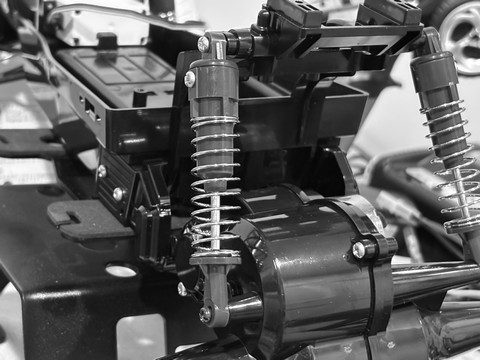
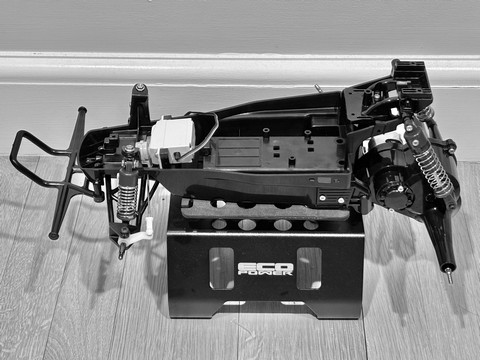
At first, I use white tack to temporarily mount the electronics in various configurations so I can see how the wires might go. The ESC switch does not fit in the switch cutout in the chassis. There's space for the switch to come out the back left side of the body. I want the battery connector to be easily accessible through the window so I don't have to take the battery out to charge it. I find a configuration where it is easy to connect and disconnect the battery, the ESC wires can easily reach motor, and it is easy to reach the ESC switch, and the switch is protected. Also, the receiver is far from the motor. I don't know if motors interfere with today's receivers but I might as well keep them far apart. I mount the switch behind the left side of the chassis.
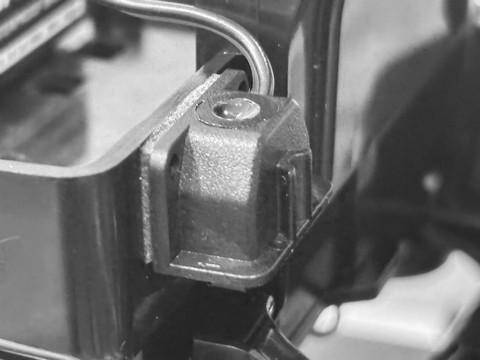
I coil the wires around a thin screwdriver shank before I plug them into the receiver.

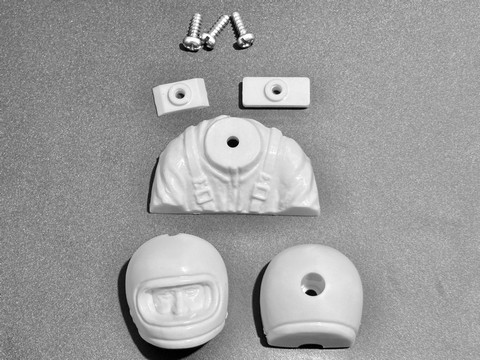
When screwing the driver's head together, I strip the screw by accident, so I glue the halves together instead.
The tires form a tight seal around the wheel. If I smoosh the tire, it doesn't go back to its original shape.

I expect the rear hex hubs to be plastic, but instead they are hefty, solid metal.

The body hugs the front shock mounts. The body color is a slightly lighter blue than the shocks. As expected, the low-torque servo makes it easy to position the front wheels the way I want without having to turn on the car. The Rising Fighter still looks a bit squished in 3/4 view photos, but not from other perspectives or in real life.


I'll be storing it in a plastic box. I plan to drive it and just stick it back into the box without feeling compelled to clean it like my other cars.

Time to Drive!
Even with the stock plastic bushings and stock 540 motor, the Rising Fighter is peppy.
I was worried that the gearbox slap would be as loud as the Midnight Pumpkin, but it wasn't bothersome at all. I was also worried that the rear wheels would bounce so much upon acceleration as to hinder control or enjoyment. It certainly bounced, and it is more noticeable on the asphalt driveway than on the grass, but it did not hinder control or enjoyment at all. In fact, I like the bounce. It's an energetic, bouncy buggy.
Steering is not a problem. The “Not best in precision", 0.18-second servo works very well.
When I go in reverse and then forward in certain spots in the yard, the Rising Fighter pops a wheelie! The wing acts as a wheelie bar and stops the car from flipping over completely, which is cool.

It gets air time jumping off of the homemade ramp. (The ramp is a 1/4"-thick 24" x 36" HDPE sheet on a window planter box.)

Sometimes it flies gracefully through the air, perfectly balanced. Once in a while, it nosedives and bounces on its front bumper. Sometimes it lands perfectly with jovial bounces, and other times it bounces so much it flips. The best landing is when it immediately pops into a wheelie.
When I miss the jump slightly and the ramp’s edge slides under the rear wheel and rubs against the plastic parts of the car, I don’t worry about damaging the rear A-arms because there aren’t any! The one-piece gearbox plus rear axle is solid.
Rarely, the car gets stuck with one rear wheel off the ground and you can’t get free because of the gear differential, but this happens so rarely that I'm glad I did not lock the differential.
It is a bit damp outside, so it gets pretty dirty.

As planned, I just put it back into the box after shaking it off a bit. No cleaning required!
First Battle Scar
Maybe after the fifth time I take it out and repeatedly jump it and land in all sorts of ways, I take it inside and notice that one screw is missing on the body and the other screw's mount is broken so that the rear of the body is no longer fastened to the chassis. The body is still firmly attached to the chassis by the third screw at the front of the car, which is why I didn't notice it while driving. I will leave it for now since it doesn't affect the car's performance or my enjoyment of it. If I do fix it, I might add foam body post washers in between the body and chassis to help absorb some impact.

There are also some stress marks on the wing.

What’s Next
I have only driven it on short grass and a small driveway so far. Someday I will drive it in a parking lot and baseball diamond.
The blue body looks great without decals. If I ever want a different color I will sand, then hand-paint it. Maybe I will paint the driver which I have never done before.
If I do paint the body, I will consider black. Here is someone else's black Rising Fighter. It occurred to me that TRF not only stands for Tamiya Racing Factory, but also Tamiya Rising Fighter.

Gold shocks with black springs and black wheel nuts might look cool.
I miss the brushed motors from the 80s and 90s that had colorful and fun labels like Trinity Monster Horsepower and Twister Pocket Rocket and Slot Machine, so that’s another option.
Conclusion
The Rising Fighter is a sleeper and underrated. You don’t need ball bearings, paint, oil-filled shocks, a locked differential, or a faster motor to get a lot of enjoyment from the Rising Fighter. It’s inexpensive, high-quality, and fun.